Using the Transfer Duty field
Curia calculates the transfer duty estimate automatically as you fill in the review and includes it in the client report.
Transfer duty (stamp duty) is calculated automatically as you fill in the review. The estimate appears on the Exchange tab and feeds the transfer duty paragraph in the client report. Curia keeps the rates in line with the state revenue offices; you don’t need to apply rate changes yourself.
Where the estimate appears
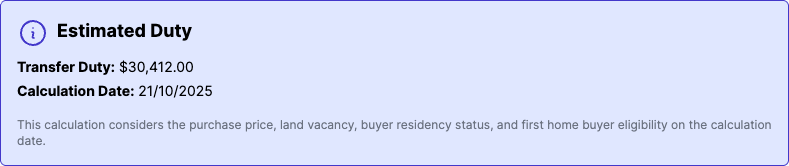
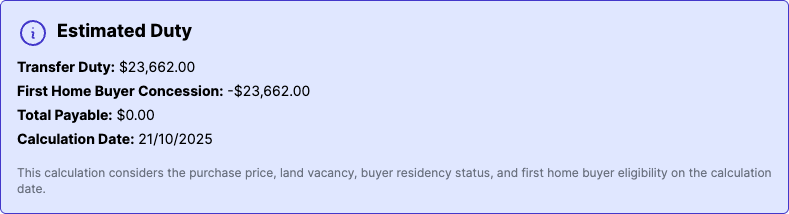
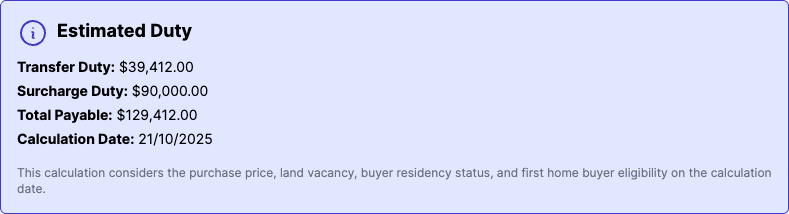
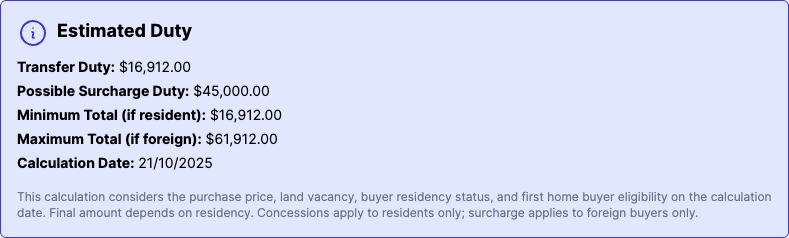
The Estimated Duty card sits on the Exchange tab, directly below the Purchase Price field. It shows the standard duty amount, any concession or surcharge, the total payable and the calculation date. The card updates whenever you change a field that affects the calculation.
The estimate is calculated automatically and cannot be overridden in Curia. If you need to change the duty figures in the report, edit the report in Microsoft Word after downloading it.
What drives the calculation
Curia uses the duty rates in force on the contract exchange date. If the contract has not been exchanged, today’s date is used instead. The fields that drive the estimate are:
- Purchase price
- Purchase price GST: a price marked ex GST has GST added before duty is calculated, unless Purchaser GST liability is Not liable.
- Property state (detected from the property address)
- The residency status of each linked client contact
- Ownership structure and any ownership shares, when there is more than one purchaser
- First home buyer assistance scheme eligibility (NSW) or First home buyer duty concession (VIC)
- Investment property
- Vacant land (NSW only, detected from the improvements on the contract)
Residency status is recorded against each client contact on the Client tab. Curia treats Australian citizen, Exempt permanent resident and Ordinarily resident as resident scenarios and Foreign person as the surcharge scenario. A company contact has its own options: Not a foreign corporation is a resident scenario and Foreign corporation is the surcharge scenario. When the purchasers’ statuses differ, Curia uses the one with the greatest duty consequence, so a single foreign purchaser brings the surcharge into the estimate. With no client contact linked, residency is treated as unknown.
The first home buyer eligibility field and Investment property each take Yes, No or Unknown.
When an input is unknown
Residency status, the first home buyer eligibility field and Investment property each offer an Unknown option for when the purchaser’s position isn’t confirmed yet. Set any of them to Unknown and Curia works out every outcome those inputs allow instead of a single figure. For residency, one linked contact set to Unknown is enough, unless another purchaser is a Foreign person or Foreign corporation.
The Estimated Duty card then shows the spread: a Minimum Total and a Maximum Total, with any concession or surcharge that applies in only some outcomes marked as possible (for example Possible First Home Buyer Concession or Possible Surcharge Duty).
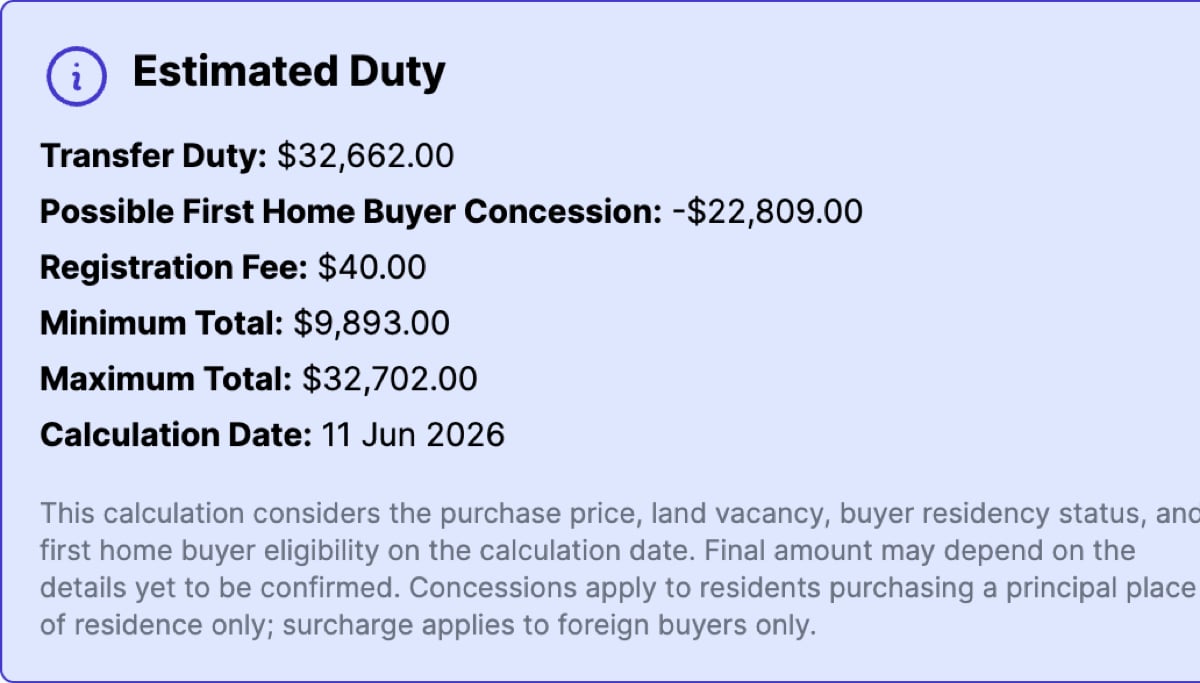
The client report presents the same range, estimating duty between a low and a high figure and noting that the amount depends on the details still to be confirmed. When residency status is unknown, the report also asks the client to confirm their residency status.
Concessions and surcharges
When the inputs above indicate a first home buyer or foreign buyer scenario, Curia applies the relevant concession or surcharge automatically and the Estimated Duty card shows it as a separate line.
When some purchasers are resident and others are foreign or have an unconfirmed residency, Curia assesses the surcharge on the share held by the non-resident purchasers rather than on the whole property. Under Tenants in Common with a share recorded for every purchaser, that is the recorded share; otherwise the purchasers are treated as holding equal shares. The report states the value the surcharge was assessed on.
NSW NSW: details specific to New South Wales reviews
- First home buyer concession. When First home buyer assistance scheme eligibility is set to Yes, Curia applies the NSW first home buyer exemption or sliding-scale concession to the standard duty. The concession does not apply to foreign buyers or to investment purchases.
- Foreign buyer surcharge. When a purchaser’s residency status is Foreign person or Foreign corporation, Curia adds the NSW foreign buyer surcharge on top of the standard duty.
For the specific thresholds, rates and formulas, refer to Revenue NSW.
VIC VIC: details specific to Victoria reviews
- PPR vs investment. Curia uses Investment property to route the calculation between the Principal Place of Residence and general rate scales. Set the field to No for a PPR purchase, Yes for an investment purchase, or Unknown if it isn’t confirmed yet.
- First home buyer. When First home buyer duty concession is set to Yes, Curia applies the VIC first home buyer exemption or sliding-scale concession to the standard duty. The concession does not apply to foreign buyers or to investment purchases.
- Foreign buyer surcharge. When a purchaser’s residency status is Foreign person or Foreign corporation, Curia adds the VIC foreign buyer surcharge on top of the standard duty.
For the specific thresholds, rates and formulas, refer to the Victorian SRO.
Off-the-plan contracts
For off-the-plan (OTP) contracts in Victoria, the Estimated Duty card shows duty calculated on the full purchase price. The SRO off-the-plan concession, which reduces the dutiable value by excluding construction or refurbishment costs incurred after the contract date, is not factored into the estimate. The amount your client may actually owe can therefore be lower than the figure shown.
The report template includes conditional text on unregistered properties that flags this to the client. To work out an OTP-adjusted figure, use the SRO calculator at sro.vic.gov.au and advise your client separately.
Other concessions
Curia only calculates the concessions described above on this page. Other Victorian duty concessions, such as the pensioner concession and the principal place of residence concession for current and former Australian Defence Force members, are not factored into the Estimated Duty card. If your client may be eligible for one of these, use the SRO calculator at sro.vic.gov.au and advise them separately.
Land title fee
VIC VIC: details specific to Victoria reviews
Separate from transfer duty, Curia estimates the land title fee, the fee the Registrar of Titles charges to register the transfer. On the Exchange tab, the Estimated Duty card shows it as a Land title fee line, and the client report states it separately from the transfer duty figure.
The estimate is based on the purchase price and the date used for the duty calculation, and assumes electronic lodgement of a standard transfer. Fees for a mortgage, discharge of mortgage, easement or paper lodgement are additional and not included.
What appears in the report
Curia generates a tailored transfer duty paragraph in the client report, and the report lists each purchaser with their own residency status. The wording varies with residency, first home buyer status, foreign purchaser surcharge, vacant land and off-the-plan context. If the purchase price has not been entered, a fallback paragraph describes the duty type and any surcharge or concession context based on the other inputs.
FAQ
Can I override the calculated duty?
No. The duty figure is calculated automatically. To change the wording or numbers in the report, edit the downloaded report in Microsoft Word.
What if I don’t know the client’s residency status?
Set the contact’s residency status to Unknown on the Client tab. The report shows a range covering both a resident outcome and a foreign buyer outcome, and asks the client to confirm.
What if I don’t know whether the purchaser is a first home buyer or an investor?
Leave the first home buyer eligibility field or Investment property set to Unknown. The Estimated Duty card and the report then show a duty range.
Are the rates kept up to date?
Yes. Curia updates the state rate tables when the revenue offices change rates or thresholds. The estimate uses the rates effective on the contract exchange date, or today’s date if the contract has not been exchanged.
Are these figures the final amount payable?
No. Duty estimates should be confirmed with the relevant state revenue office.